
In 1994, a single phone call changed the name of what became Amazon.
Jeff Bezos had already picked a name for his online bookstore: Cadabra, as in abracadabra. He liked it. But when he said it aloud to his lawyer over the phone, the lawyer heard something else, "cadaver?", and Bezos reconsidered.
He'd stumbled onto an easy-to-miss truth in branding: a name doesn't live on paper. It lives in the ear.
Most founders name their company with their eyes. They look at the word on a screen, check if the .com is available, and move on. But your customers will rarely first encounter your name the way you do. They'll hear it, from a friend, on a podcast, in a noisy bar, over a bad phone connection, and then try to find you. If they can't spell it after hearing it once, many of them won't reach you at all.
This is the Radio Test, and it's easy to skip.
What the Radio Test measures
The Radio Test asks a simple question: if someone hears your name once, out loud, with no context, can they spell it correctly and find you?
It sounds trivial, but there are a lot of ways a spoken name can go wrong.
A name can be misheard. "Flare" and "flair" sound identical; so do "vein" and "vain." A customer who hears one and types the other into a search bar has no way to know which you meant.
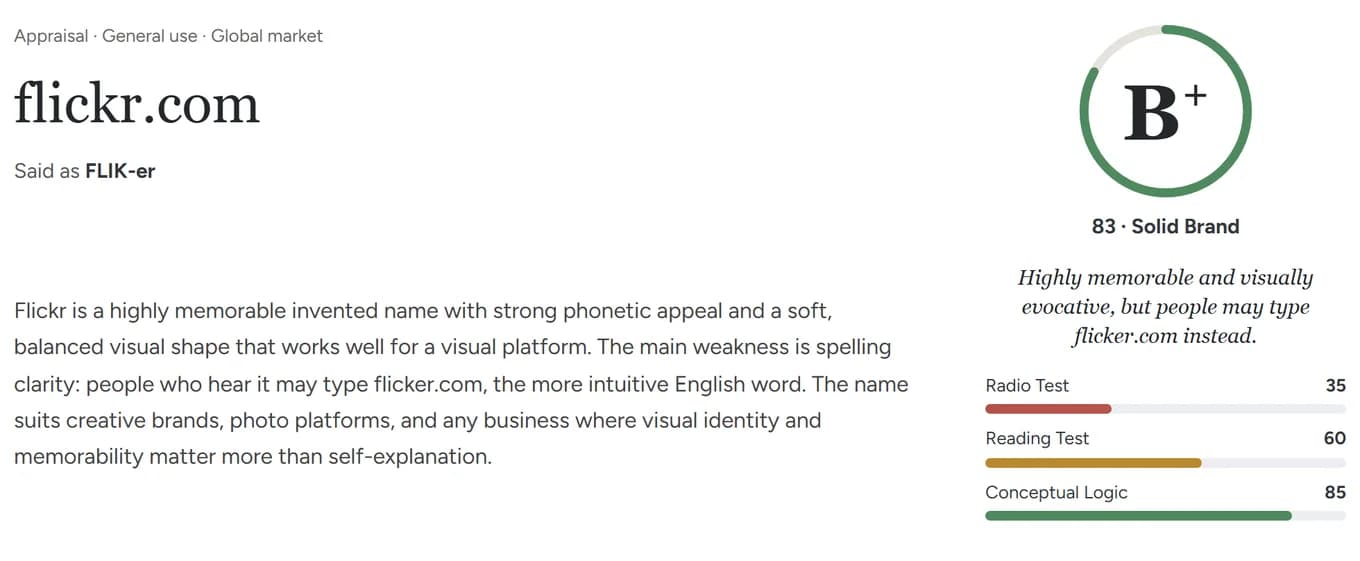
A name can be unspellable. Say "Flickr" out loud, nothing in the sound tells you to drop the e. Flickr owns flicker.com and redirects everyone who types it the natural way. Not every company can do that.
A name can be ambiguous in structure. Is it one word or two? Is there a hyphen? "Get Response," "GetResponse," "Get-Response", each version is a fork where some fraction of your audience takes the wrong turn.
The Radio Test isn't about whether a name is clever. It's about whether it survives the trip from one person's mouth to another person's keyboard, and that trip is where a lot of word-of-mouth quietly gets lost.
Why founders keep failing it
If the Radio Test matters so much, why do smart people get it wrong?
Because when you name something, you already know the answer. You know it's spelled with two t's, you know the pun inside it, you know it's one word and not two. It's what psychologists call the curse of knowledge, you can't un-know how your own name is spelled, so you can't hear it the way a stranger does.
That makes the founder a poor judge of their own name's clarity. The name that feels obvious to you can be a coin flip to everyone else. And the customers who mishear it and give up never show in your analytics, they simply don't arrive. You see the traffic that made it through; you never see the traffic that got lost on the way.
What the names that pass have in common
Names that survive the Radio Test tend to share a few traits.
They're phonetically clear, every sound maps to one spelling. Stripe. Square. Notion. You hear them, you spell them, done.
They lean on real words or familiar sounds, giving the listener something to hold onto. An invented name with no anchor ("Zentrik") asks people to memorize an arbitrary string of sounds. A real word (Slack, Discord, Notion) gives them a handrail.
They avoid homophones and near-misses, no "vein/vain," no name that sounds like a more common word people will default to instead.
How to test your own name
You can run a rough Radio Test yourself before spending anything on a logo.
Say your name out loud to a few people who've never heard it. Don't spell it, don't show them, just say it once. Then ask them to write it down.
If they spell it correctly, it travels. If someone hesitates or gets it wrong, you've found a leak, one that follows the company around, costing you a little on every referral and word-of-mouth mention.
The limit of the DIY version is that a few friends isn't a big sample, and people are often too polite to tell you a name is confusing. That's part of why we built Pranced, to run the Radio Test systematically, scoring a name by how it's actually heard and spelled, not how it looks.
The cheapest thing to get right
A good name and a mediocre one cost the same to register, about eleven dollars. The difference shows up later. A name that's hard to hear and spell quietly costs you on every referral; a clear one doesn't.
Getting the name right is nearly free at the start and expensive to fix once you've built on top of it. So before settling on how a name looks, it's worth closing your eyes and listening to it first, it's one of the few problems that's cheap to catch and costly to ignore.